
Redemption!

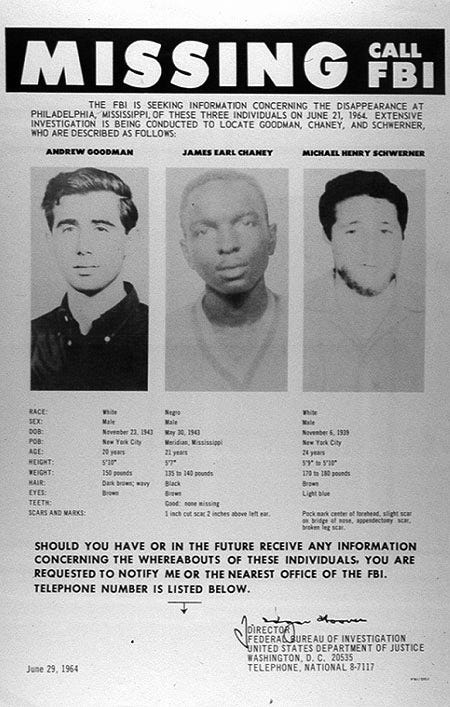
FBI missing persons poster for civil rights workers, summer 1964 (image credit: FBI.gov)
So the Supremes handed down their decision in Louisiana v. Callais at the end of last month, effectively striking down what was left of the Voting Rights Act of 1965 (a decision in 2013, Shelby County v. Holder, struck down the Section 5 pre-clearance requirement; this decision also strikes down the Section 2 individual cause of action as it applies to redistricting). This is the law those three guys I discussed last week, James Chaney, Andrew Goodman, and Michael Schwerner, died for in the Mississippi Summer campaign of 1964. This was the law that John Lewis got his skull broken by a racist cop marching from Selma to Montgomery Alabama for. This was the law that Congress repeatedly reauthorized, most recently in 2006 by a unanimous vote in the Senate and 390-33 in the House when SCOTUS dealt a couple of earlier blows to the bill under similar “logic”, if you want to call it that, as this decision. The conservative majority on the court decided, contra the considered opinion of the vast majority of members of Congress and that noted liberal squish George W. Bush in 2006, that there is no more racism in America and so, as Chief “Justice” Roberts famously said in 2007, “the way to stop discrimination on the basis of race is to stop discriminating on the basis of race”. In case anybody needed reminding that they’ve stopped being a court and are now just another political branch.
The states of the former Confederate States of America have heard the call. They are currently in the process of redrawing their congressional maps to make sure that there are as few Black – excuse me, Democratic – representatives as possible. Louisiana went so far as to cancel its upcoming elections, in which voting had already begun, in order to draw a new map that would eliminate majority-minority districts and ensure (they hope) an entirely Republican congressional delegation from the state. Tennessee called an emergency legislative session and redistricted overnight, meanwhile throwing Black representatives out of the chamber as they protested. Alabama has an ongoing case and will now be allowed to return to its 2021 map, which had earlier been found to be a violation of the VRA. All of this, of course, is a clear violation of the Supremes’ earlier principle in Purcell v. Gonzalez, from the shadow docket back in 2006, that says you can’t change the rules just before an election. But this principle obviously only applies when the rules change would benefit a Democratic candidate, as, for example, when the court refused to stay a Virginia Supreme Court ruling overturning the voter-approved pro-Democratic gerrymander in that state.
So, like I said in my very first post on this site back last summer, we are headed back to the good old days of the 19th century. This court is very like the “Redemption Court” of the post Civil War era, the one that struck down the 14th Amendment in the Slaughterhouse Cases and the Civil Rights Cases, as I outlined there. Their decision here, though, is more like the somewhat later SCOTUS jurisprudence that effectively struck down the 15th Amendment by allowing states to pass laws that, while they did not mention race explicitly, nevertheless effectively deprived Blacks of the right to vote. In Williams v. Mississippi in 1898 SCOTUS permitted the state to use literacy tests, a poll tax, and a grandfather clause, all administered by local registrars, to deny all but a few of its hundreds of thousands of Black citizens of their votes. The argument was that the administrative decisions of local registrars were not justiciable in the federal court system. All the other southern states followed suit, and in 1965 when the VRA was passed, no former Confederate state allowed more than 1/3 of its Black citizens to vote and in the deep south states the proportion was less than 10%.
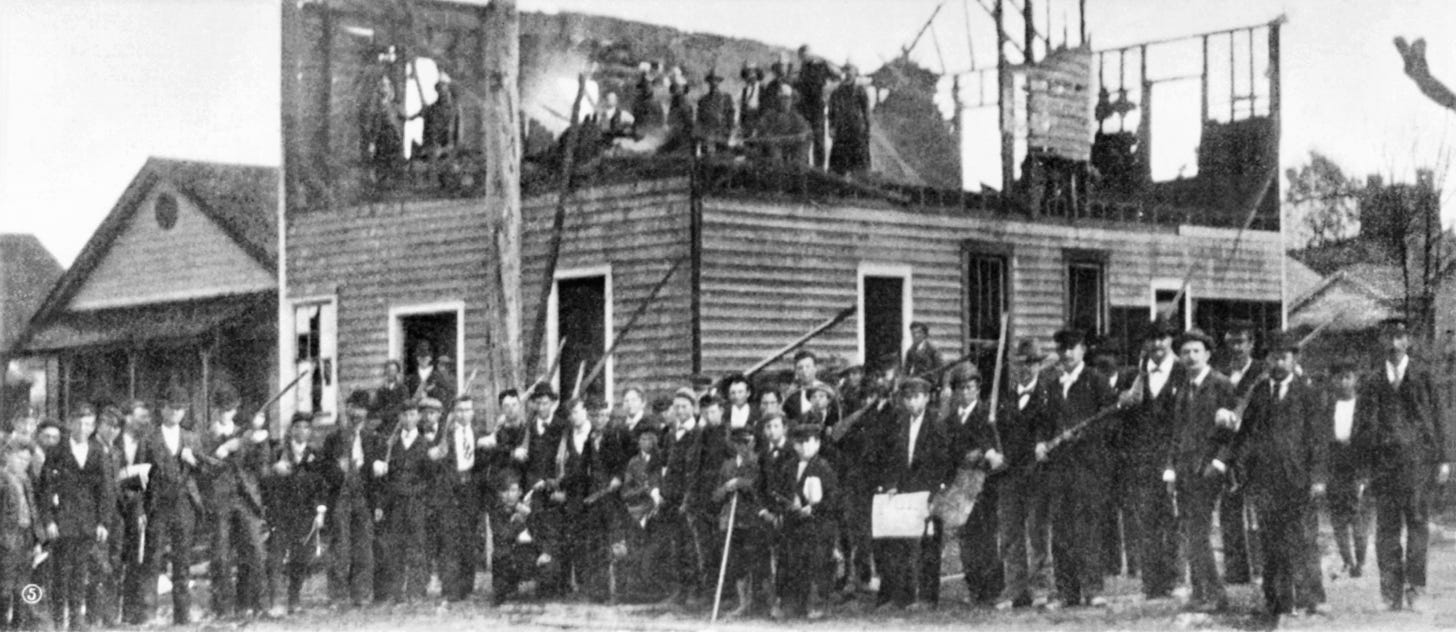
A mob of White militia in 1898 in Wilmington NC who burned a newspaper office that supported Black civil rights (image credit: Library of Congress)
At this point, nobody is talking about reintroducing literacy tests, or their cousins, good character tests, where a person wishing to register to vote for the first time had to bring in character witnesses – who had to be registered voters – to vouch for them. Easy enough for White folks, a little harder for Blacks. With the computerized tools at their disposal, gerrymandering will permit the White supremacists to draw district lines so that minority communities are “cracked” – divided up into little chunks and assigned to majority White districts – or, if that isn’t possible, “packed” – crammed together into a single district that will select one non-White representative to be outvoted by dozens of White Republicans. There’s a possibility that this will be a “dummymander” that will create a bunch of districts that are winnable for Democrats in a good year by combining the votes of the few liberal Whites, the now larger Black minority, and disaffected centrists, while Republicans disappointed with the Orange Messiah’s inability to deliver cheap eggs stay home.
There were moments like this in the Redemption Era too. In the late 19th century, facing a severe economic downturn that hammered southern farmers of both races, the Republicans (at that time still the party of racial justice) and the Populists united to take power in North Carolina. Large numbers of Blacks still could vote, and were reliable Republicans, but had been systematically excluded from power. But the united political movement was strong enough to take power in several parts of the state by 1896. A combination of improving economic conditions, promised social welfare spending on Whites by Democratic office holders, and a violent coup in Wilmington that overthrew the largest local government controlled by fusionists, however, meant the end of the movement. As soon as Democrats regained power in the southern states where Populist and fusionist movements had been strong, that was when they imposed new voting requirements designed, as the President of the Alabama Constitutional Convention of 1901 said, “to establish White supremacy in this state.”
So we should not hold our breaths waiting for elections to save us. As I’ve been saying since the beginning of this nightmare, the conventional political process, norms, institutions, etc., are not going to save us; only we can save ourselves, on the streets. If we end up getting our victory in 2026 stolen by ballot shenanigans, maybe that will be enough to wake the American people up from their frog boiling stupor and they will rise up and destroy this fascist regime.
I had some more thoughts about a subject I discussed a while ago: what to do if we manage to regain power (I notice that I mentioned the Callais case in there; it has been hanging fire for a while now). One thing we can do is actually impose the sanctions that the 14th Amendment requires. For one thing, anyone who has taken an oath of office to defend the Constitution (which all federal, state, and local office holders, civil servants, and members of the military have to do) and who then participates in rebellion is ineligible for any public office. SCOTUS in the infamous Trump v. Anderson case said that Congress has to invoke this inability instead of, as the amendment provides, Congress having the power to waive ineligibility (assumed, and implemented by states in the original meaning of the Amendment) by a 2/3 vote. Nevertheless, Congress can and should use this power to declare that Donald Trump was ineligible to serve as president after his participation in the January 6th 2021 insurrection. Presumably, since Section 5 of the amendment grants Congress the power to enforce the amendment, and for this reason the court in Trump v. Anderson said it did not have power to review these decisions, Congress could do this without the president or courts having the power to overturn their actions. If they pass such a resolution, the presidency would be vacant, would have been vacant since January 20th 2025, and all presidential actions since that date would be of no effect. All the people they fired get their jobs back. All the appointments are voided. All the laws he signed are not laws. All court filings are rescinded. Of course, J.D. Vance would become president and could do some of these things again, but now we are warned and could stand up to him.
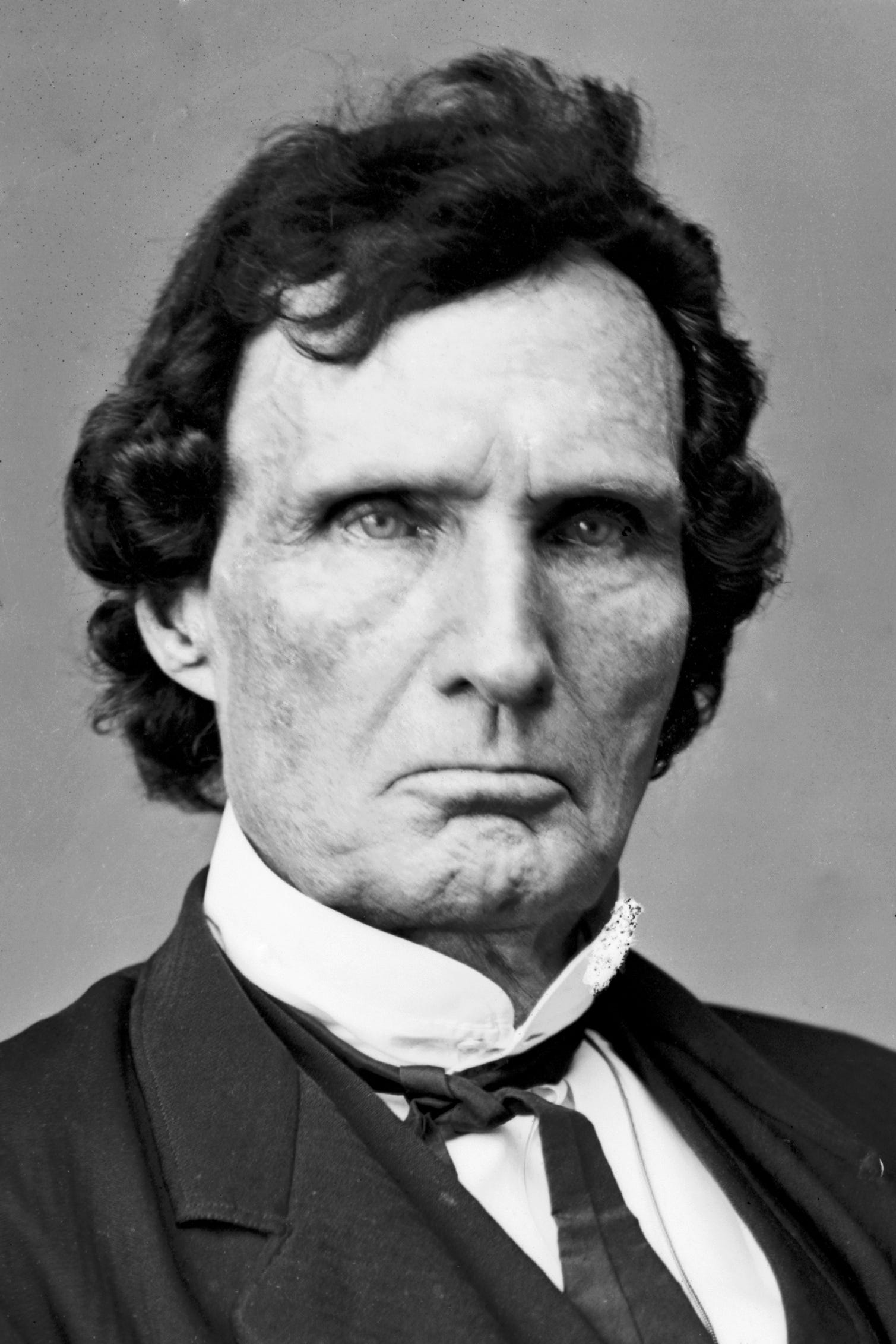
Congressman Thaddeus Stevens, 1865 (image credit: By Mathew Benjamin Brady / Levin Corbin Handy – Library of Congress )
Another power Congress has is to determine the eligibility of its own members. This is a power under Article I Section 5 that is inherent in each house and does not rely on the president or courts. A majority in Congress could determine that people elected under unfair redistricting plans designed to deprive minorities of voting power were not eligible to serve. There is precedent here: in December 1865, as Congress met for its first session since the end of the Civil War and newly elected representatives arrived from the southern states that had seceded, leadership just refused to swear them in. Adding insult to injury in this case was that the states got more members of the House than they had before the war because the 3/5 clause (basing representation in the House and electoral votes on the whole population of free persons plus 3/5 of the slaves) was no longer in effect because the 13th Amendment had abolished slavery, but none of the southern states had allowed Blacks to vote. Most of the people who came back to Congress in 1865 were the same folks who had been there in 1861 before the war, except for those who had died in the act of breaking their oaths to the Constitution, and reinforced by similarly-minded allies. If we can take power, we can do as Thaddeus Stevens did and bar a lot of the fascists from office. Back in the Biden administration Democrats tried to pass a law requiring nonpartisan redistricting and a lot of other voting rights changes. It didn’t pass because of the filibuster in the Senate but these days anything like that even if it got through the Senate would never get a presidential signature. But the nice thing about the Section 5 power is that a majority of each house of Congress could invoke it for their body without anybody else having anything to say about it. And Republicans crying foul would be hypocrites; they refused to swear in Adelita Grijalva for months to keep the Epstein files bill from coming to a vote. Not that hypocrisy has ever stopped a politician from doing anything.
Section 2 of the 14th Amendment says that states that deprive some of their (male) citizens of the right to vote shall have their representation in the House decreased in proportion. This provision was originally intended to eliminate that advantage southern states got from the end of the 3/5 clause while not extending the right to vote to their Black citizens, and then was superseded to some extent by the 15th Amendment. But since the court has now struck down the 15th Amendment, maybe we need to reconsider Section 2. The nice thing about this section is that the “basis for representation” is reduced in full proportion to the citizens denied their right to vote, not just the right of its representatives to take their seats in the House. Since a state’s electoral votes are based on its number of representatives plus senators, this would also reduce the electoral votes of states that disenfranchise their citizens. This would be a function of reapportionment, and have to be done by a law, with a presidential signature, or passed by a 2/3 majority in each house over a veto. We need to reapportion anyway, since one very important step towards making this country a functioning democracy will be to dramatically increase the size of the House of Representatives (and maybe also the Senate, which would require a constitutional amendment). We could do this at the same time, with a better chance of passing it over President Vance’s veto if we have previously barred a bunch of Republicans under Article I Section 5 power.
And then, of course, we have to fix the court. Any laws we pass in this period have to include jurisdiction stripping provisions. Congress has the power to define the jurisdiction of the federal courts under various provisions of the Constitution. We need to make sure that the current lot of fascist bootlickers don’t get their hands on our laws. Ultimately, we will do that by changing the structure of the courts, but for the nonce, just make sure they don’t have any right to say anything.